


Energy & Oil Gas
Public Private Partnership backs Hydrogen Engineering
In what the Queensland government believes is Australia’s biggest investment in green hydrogen so far, almost $117 million, has been made by the Queensland and federal governments and...
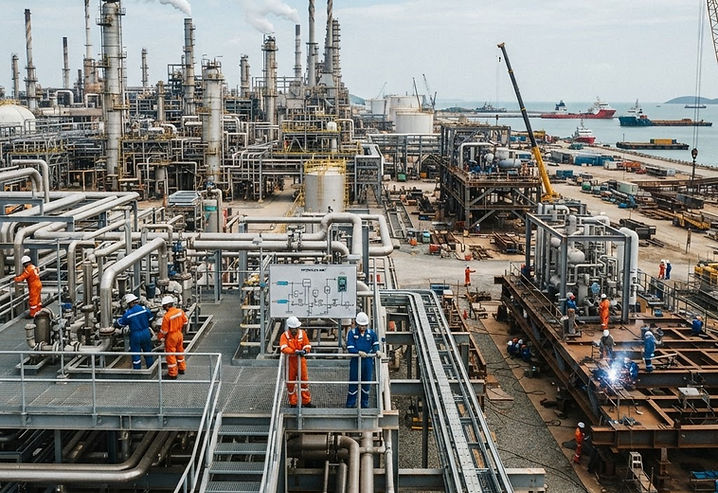
In what the Queensland government believes is Australia’s biggest investment in green hydrogen so far, almost $117 million, has been made by the Queensland and federal governments and a consortium to fund the front end engineering design for the Central Queensland Hydrogen (CQ H2) project at Gladstone. When completed, the engineering design will bring the project closer to a final decision, expected late next year. Green hydrogen can decarbonize oil and gas, manufacturing, heavy haulage, shipping, aviation, heat induction bending services, and other industries. The project will be powered by renewable energy and is expected to produce 200 tons of hydrogen a day by 2028, rising to 800 tons a day by 2031. That is equivalent to fueling more than double Australia’s fleet of heavy vehicles. The hydrogen needs to be liquified or converted to ammonia for export and potentially local industry offtake.
The Australian Renewable Energy Agency (ARENA) will provide $20 million in funding, $15 million will be from the Palaszczuk Government and the remainder $81.8 million from consortium partners which are passionate about green hydrogen. These consortium partners are: Iwatani Corporation (Japan), Kansai Electric Power Company (Japan), Marubeni Corporation (Japan), Keppel Infrastructure (Singapore) and Queensland’s publicly owned Stanwell Corporation. Federal Minister for Climate Change and Energy, Chris Bowen, said projects such as this are critical to scaling up Australia’s green hydrogen industry. “The government is committed to making Australia a global hydrogen leader. Projects like the CQ H2 Project could lead the way in exporting renewable hydrogen to the international market.
“Japan, Korea and China are three of our largest trading partners and have all made clear commitments to increase the use of hydrogen, with a focus on establishing international supply chains for imports,” said Minister Bowen. Queensland Premier, Annastacia Palaszczuk said the international partnership highlights Queensland’s position as a global hydrogen heavyweight. “Because of the investments we’remaking, the Queensland economy will reap the benefits of the global clean energy transition, while ensuring Queensland has more and cheaper, cleaner renewable energy to power our businesses and homes,” she said. Developing a green hydrogen export industry in Gladstone will create significant economic opportunities for Queensland: project is expected to create almost 9,000 jobs, including in the steel fabrication industry, and over $17.2 billion in hydrogen exports in its 30 year life.
Queensland Treasurer and Minister for Trade and Investment Cameron Dick said it was the largest green hydrogen investment of its kind in the nation’s history. “It is … an endorsement of the Palaszczuk Government’s Energy and Jobs Plan,” he said. “The Palaszczuk Government is working hard to drive the state’s hydrogen industry forward, to create highly skilled jobs, especially in regional Queensland. “That’s why, through the Treasury’s Queensland Renewable Energy and Hydrogen Jobs Fund, we invested $15 million into this stage of the project.” The Queensland government believes the public private partnership in the CQ H2 project is within the top 10 hydrogen projects in the world, which includes the EU plan to replace Russian fuel with hydrogen. The project will complement other planned investments in a renewable hydrogen industry in the Gladstone region, including the Commonwealth Government’s Regional Hydrogen Hubs program. Michael O’Rourke, CEO of government owned energy generator and provider Stanwell Corporation said the project could create thousands of jobs and deliver billions of dollars in economic benefit. “We are proud to be leading the CQ H2 project with our partners, which demonstrates our commitment to driving the development of Queensland’s hydrogen industry and other new technologies.
K999 Thailand carries out work of this kind through its pressure vessel fabrication team in Rayong.
Further reading
Follow procurement opportunities across the wider market on Project Atlas Intel.
How K999 can help
Process equipment for energy projects
Pressure containment and pipeline work carries the tightest documentation on the shop floor, and the articles here track the codes and market conditions behind that work.
Pressure vessels and tanks- 01
Pressure vessels, steel tanks and pig launchers built to ASME and client specifications.
- 02
Pipe spool fabrication with heat induction bending for long radius and tight radius bends.
- 03
Full traceability from mill certificates through weld maps to hydrotest records.
More on Energy & Oil Gas
All articles


Request for quotation
Need fabricated steel to that standard?
Every enquiry is answered within 48 hours by our estimating team in Rayong. The priced quotation follows once drawings, quantities and standards are confirmed. Stainless steel fabrication, structural steel fabrication, pipe spooling, pressure vessels, steel tanks, mining equipment and conveyors, pig launchers, chutes and hoppers, send the package and we will price it.
Before you request a quotation
Steel fabrication quotation questions
What structural steel fabrication, pressure vessel and pipe spooling packages cost, what to send with an enquiry, and how delivery to site works.
Structural steel fabrication is priced from the section and plate tonnage, the detailing and drawing hours, welding and fitting manhours, NDT requirements, blast and coating system, packing and freight. Grade matters as much as weight: AS/NZS, ASTM, JIS and BS sections carry different mill prices, and heavy built up members take longer than rolled sections. Our Rayong workshop produces around 10,000 tonnes of structural steel fabrication a year, so a clear bill of materials is usually enough to price. Send the drawings and we answer within 48 hours; the priced quotation follows once quantities, standards and delivery dates are confirmed.
For steel fabrication work, send the drawings or IFC package, a bill of materials with material grades, the welding and NDT requirements, the coating specification, the delivery port and your site dates. Add the inspection and test plan, any third party inspection requirement, and whether trial assembly or match marking is needed. Where drawings are still in progress, a scope list with sizes, quantities and duty is enough to start, and the estimate is refined once the final package arrives. Every enquiry is answered within 48 hours, and the priced quotation is issued after scope, standards and quantities are confirmed.
Yes. Pressure vessel fabrication is carried out to ASME Section VIII Div. 1 under our ASME U stamp No. 43,462, or to AS/NZS and BS where the project specifies, covering separators, air receivers, water drums, waste heat recovery units and pig launchers. Steel tanks for fuel, biofuel, chemical, water and food duty are designed in house with our E Tank programme to API, ASME, BS and AS/NZS. Because structural steel, vessels, tanks and their supports are built in the same workshops, one enquiry can cover the vessel package, the tank package and the structural steel that carries them, with a single coating and documentation system and one shipment.
Steel fabrication Australia packages are scheduled from a 33,000 m2 Rayong yard with an 80,000 m2 assembly yard inside Sattahip port, so fabrication, trial assembly, blasting, coating and packing run in one place. Programme length depends on tonnage, material lead times, the coating system and inspection scope, and it is confirmed with the quotation. We quote FOB Laem Chabang, Map Ta Phut or Sattahip, or CIF and DAP to your Australian port, with packing lists, weights, lifting points and a data book per shipment. Staged deliveries can follow your site erection sequence instead of shipping everything at once.
There is no fixed minimum. Pipe spooling Australia packages run at up to 3,000 diameter inches per shift on SCH.40, from a single replacement spool to a full plant piping scope, with spools numbered, X rayed where specified and coated to match erection order. Mining equipment fabrication covers chutes, hoppers, ore bins, transfer towers and conveyor structures with Bisalloy, Hardox, rubber lining or hardfacing fitted in house, from one wear liner set to modules of up to 2,500 tonnes assembled at Sattahip. Send the scope list and we will tell you what the smallest sensible batch is for your programme.