


Welding & Testing
TIG and MIG - Difference in Welding Types
TIG for precision and thin sections, MIG for speed and deposition, and how to choose the process that suits the joint and the welding code.
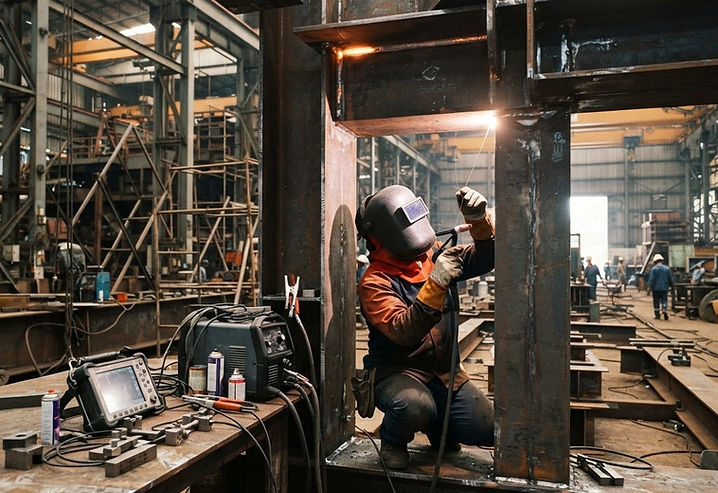
Welding is an essential process in most fabrication jobs, with applications in both heavy and light metal fabrication. Different energy sources are used for welding, with a variety of available techniques. Until the end of the 19th century, forge welding was the only method used, but later processes, such as arc welding, have since been developed. Modern methods use gas flame, electric arc, lasers, electron beam, friction and even ultrasound to join materials and have applications in industries such as mining plant and equipment. Two commonly used welding techniques are TIG and MIG welding, this blog will look to discuss their individual characteristics, pros and cons and uses in different areas.
TIG stands for Tungsten Inert Gas. This method of welding uses a nonconsumable electrode, made of tungsten, to run a high powered current through the metals being joined, and bond them permanently. One of the main differences between TIG and MIG welding is that TIG welding does not always use a “filler metal”, a wire that is melted to help join two objects together. MIG welding always uses some kind of filler, while most TIG welding projects do not. This means that TIG welding usually requires a hotter operating temperature to work correctly, as both pieces of metal must be welded at extremely hot temperatures. TIG welding is usually a better choice for joining thinner, more delicate pieces of metal. Thin metal is much easier to weld without a filler, and TIG welding will provide a more seamless, beautiful result in steel fabrication. TIG welding also provides a stronger overall bond than MIG welding, because it physically bonds both pieces of metal to one another without the addition of a large volume of filler material.
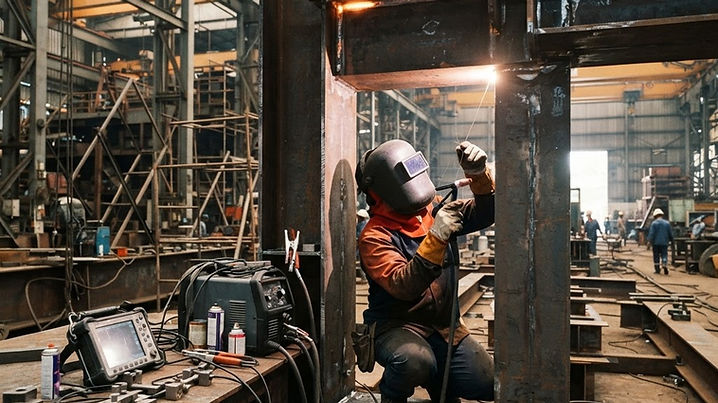
Some advantages of TIG welding are a precise finish is obtained, no filler materials are required and it is cleaner and better for the environment. A few cons are also present such as it is more expensive, more time consuming and difficult and requires a completely clean welding surface.
MIG stands for Metal Inert Gas. All MIG welders utilize a metal wire, which is used as a filler material to help bond metal objects. As the MIG welder operates, this wire is continuously melted, and bonds to each object that is being welded together. This makes MIG welding a much better choice for thick pieces of steel. Thicker metals cannot be heated up quickly enough by TIG welding, so they require some kind of filler material in order to be joined properly. For heavy steel fabrication companies, MIG welding is usually recommended, due to its ability to join thick metals very quickly. However, MIG welding is often not quite as seamless and attractive as TIG welding, making it a poor choice in areas where aesthetic perfection is desired.
MIG welding has quite a few pros such as having a shorter join time than TIG welding, being less expensive, it creating a more accurate bond and also producing a clean, maintenance free weld. Some disadvantages are it is not quite as strong as TIG welding, requires an expert welder to be effective, cannot usually be performed outdoors and it produces heavy smoke, fumes and sparks.
As can be observed, both TIG and MIG welding have different characteristics and features in the fabrication industry. TIG is a more delicate process and hence, it consumes more resources such as heat and energy. MIG involves the use of filler materials and is not as precise. With multiple techniques and products in the sheet metal fabrication industry, TIG and MIG welding techniques stand out for their versatility and ubiquity in different sectors!
K999 Thailand carries out work of this kind through its pipe spool fabrication team in Rayong.
Further reading
Follow Ports & Marine across the wider market on Project Atlas Intel.
How K999 can help
Welding and inspection practice
The welding procedures, welder qualifications and inspection routines described here are the ones applied to every spool, vessel and frame that leaves our workshop.
Inspection and expediting- 01
Qualified procedures for carbon steel, stainless steel and nickel alloys, with welder performance records held per joint type.
- 02
Dimensional and weld inspection in house, with third party witness arranged for client hold points.
- 03
Inspection and expediting support that follows the job from raw material receipt through to load out.
More on Welding & Testing
All articles


Request for quotation
Need fabricated steel to that standard?
Every enquiry is answered within 48 hours by our estimating team in Rayong. The priced quotation follows once drawings, quantities and standards are confirmed. Stainless steel fabrication, structural steel fabrication, pipe spooling, pressure vessels, steel tanks, mining equipment and conveyors, pig launchers, chutes and hoppers, send the package and we will price it.
Before you request a quotation
Steel fabrication quotation questions
What structural steel fabrication, pressure vessel and pipe spooling packages cost, what to send with an enquiry, and how delivery to site works.
Structural steel fabrication is priced from the section and plate tonnage, the detailing and drawing hours, welding and fitting manhours, NDT requirements, blast and coating system, packing and freight. Grade matters as much as weight: AS/NZS, ASTM, JIS and BS sections carry different mill prices, and heavy built up members take longer than rolled sections. Our Rayong workshop produces around 10,000 tonnes of structural steel fabrication a year, so a clear bill of materials is usually enough to price. Send the drawings and we answer within 48 hours; the priced quotation follows once quantities, standards and delivery dates are confirmed.
For steel fabrication work, send the drawings or IFC package, a bill of materials with material grades, the welding and NDT requirements, the coating specification, the delivery port and your site dates. Add the inspection and test plan, any third party inspection requirement, and whether trial assembly or match marking is needed. Where drawings are still in progress, a scope list with sizes, quantities and duty is enough to start, and the estimate is refined once the final package arrives. Every enquiry is answered within 48 hours, and the priced quotation is issued after scope, standards and quantities are confirmed.
Yes. Pressure vessel fabrication is carried out to ASME Section VIII Div. 1 under our ASME U stamp No. 43,462, or to AS/NZS and BS where the project specifies, covering separators, air receivers, water drums, waste heat recovery units and pig launchers. Steel tanks for fuel, biofuel, chemical, water and food duty are designed in house with our E Tank programme to API, ASME, BS and AS/NZS. Because structural steel, vessels, tanks and their supports are built in the same workshops, one enquiry can cover the vessel package, the tank package and the structural steel that carries them, with a single coating and documentation system and one shipment.
Steel fabrication Australia packages are scheduled from a 33,000 m2 Rayong yard with an 80,000 m2 assembly yard inside Sattahip port, so fabrication, trial assembly, blasting, coating and packing run in one place. Programme length depends on tonnage, material lead times, the coating system and inspection scope, and it is confirmed with the quotation. We quote FOB Laem Chabang, Map Ta Phut or Sattahip, or CIF and DAP to your Australian port, with packing lists, weights, lifting points and a data book per shipment. Staged deliveries can follow your site erection sequence instead of shipping everything at once.
There is no fixed minimum. Pipe spooling Australia packages run at up to 3,000 diameter inches per shift on SCH.40, from a single replacement spool to a full plant piping scope, with spools numbered, X rayed where specified and coated to match erection order. Mining equipment fabrication covers chutes, hoppers, ore bins, transfer towers and conveyor structures with Bisalloy, Hardox, rubber lining or hardfacing fitted in house, from one wear liner set to modules of up to 2,500 tonnes assembled at Sattahip. Send the scope list and we will tell you what the smallest sensible batch is for your programme.