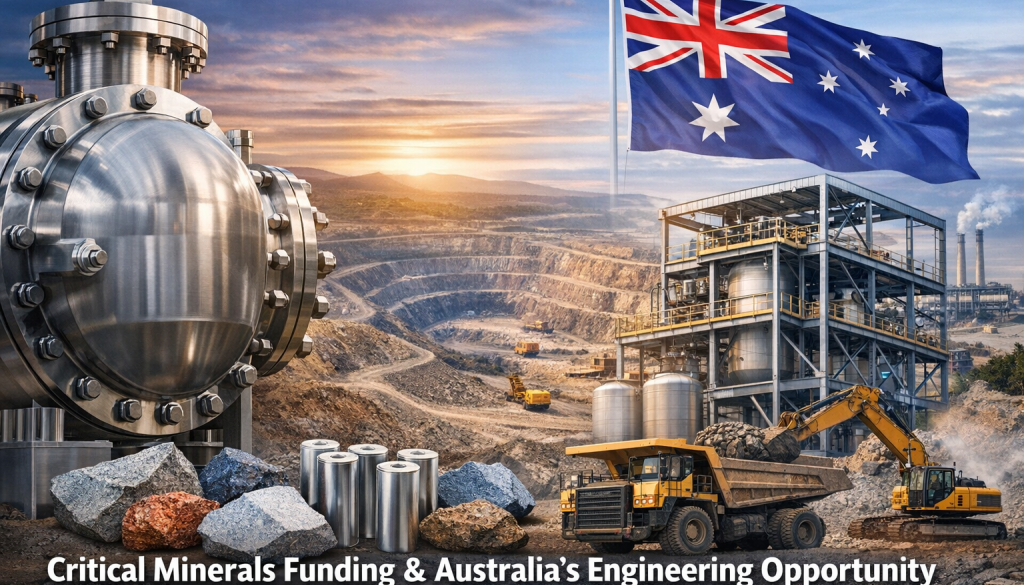
Critical Minerals Funding and Australia’s Engineering Opportunity
How Global Investment Trends Are Driving Demand for Fabrication and Industrial Infrastructure
The global race to secure critical minerals is accelerating rapidly, reshaping industrial investment priorities, supply chains, and infrastructure development. Governments, financial institutions, and private investors are committing billions of dollars to exploration, mining, processing, and logistics projects tied to minerals essential for clean energy, advanced manufacturing, and digital technologies.
For engineering and fabrication companies — particularly those supporting heavy industry — these funding trends represent significant opportunity. From stainless steel fabrication to structural steel fabrication Australia projects and pressure vessels Australia manufacturing, industrial capability will play a central role in enabling the next phase of mineral production and processing infrastructure.
This article explores the current global funding landscape and examines how Australia’s engineering sector can benefit from the expanding critical minerals ecosystem.
The Strategic Importance of Critical Minerals
Critical minerals such as lithium, cobalt, nickel, copper, graphite, and rare earth elements underpin modern industrial economies. They are essential inputs for:
-
Renewable energy systems
-
Battery storage and electric vehicles
-
Semiconductor manufacturing
-
Aerospace and defense technologies
-
Telecommunications infrastructure
Demand projections show sustained long-term growth as electrification and digitalization expand worldwide. However, supply chain concentration remains a key concern, with processing and refinement capacity heavily centralized in limited regions.
As a result, governments are investing heavily to diversify sourcing, localize processing, and strengthen industrial independence.
This shift is not only influencing mining activity — it is driving demand for engineered infrastructure, fabrication capacity, and specialized industrial equipment.
Government Funding Is Driving the Global Investment Wave
Public-sector capital has become a major catalyst for mineral development projects.
Across Europe, strategic raw material initiatives are supporting dozens of mining and processing developments backed by tens of billions of euros in capital. These programs aim to reduce import reliance and strengthen domestic industrial resilience.
North America is similarly investing through federal strategies and cross-border partnerships designed to enhance extraction, processing capability, and supply chain stability. Funding support often includes infrastructure development, innovation grants, and regional industrial investment incentives.
International collaboration agreements are also expanding, connecting resource-rich regions with manufacturing economies seeking long-term mineral security.
The result is a structural transformation — critical minerals development is now embedded within national industrial policy rather than purely driven by market forces.
Emerging Regional Investment Hotspots
Funding flows continue to reshape global resource development geography. Investment activity has increased across:
-
Southeast Asia
-
Latin America
-
Africa
-
Australia
Indonesia’s expansion into mineral processing and rare-earth development, for example, highlights how governments are positioning themselves to capture greater value from resource extraction.
Africa remains a key destination for exploration investment due to extensive untapped reserves, while Latin America continues attracting capital into lithium and copper production.
Australia, however, holds a uniquely advantageous position due to:
-
Stable regulatory frameworks
-
Established mining infrastructure
-
Skilled engineering workforce
-
Proximity to Asian manufacturing markets
These factors make the country a major destination for both domestic and international funding tied to critical mineral supply chain expansion.
Australia’s Industrial and Engineering Advantage
Australia’s role in the critical minerals value chain extends beyond extraction. Engineering capability and fabrication infrastructure are critical enablers of project delivery.
Mining and processing facilities rely heavily on:
-
Structural steel fabrication Australia providers for plant construction
-
Stainless steel fabrication for corrosion-resistant processing systems
-
Pressure vessels Australia manufacturers for refining and chemical processing
-
Material handling systems
-
Storage tanks and containment systems
-
Transport and logistics infrastructure
Local fabrication capacity improves project timelines, reduces risk, and supports national value capture from resource development.
As funding accelerates, engineering contractors capable of delivering integrated fabrication solutions are positioned to capture increasing project scope.
Infrastructure Demand from Processing Expansion
A key trend shaping funding deployment is the push toward domestic processing and refining capacity.
Historically, raw mineral export dominated supply chains. Today, policy frameworks encourage downstream processing to:
-
Create jobs
-
Increase industrial capability
-
Capture greater economic value
-
Improve supply chain security
Processing facilities require highly specialized fabrication — particularly in high-stress or chemically aggressive environments. This drives demand for:
-
High-grade stainless assemblies
-
Heavy structural frameworks
-
Custom pressure containment systems
-
Modular plant fabrication
Engineering providers with experience across these areas become critical partners in mineral infrastructure development.
Investment Risks and Market Volatility
Despite strong funding momentum, the critical minerals sector presents challenges.
Commodity price volatility can affect project feasibility, while geopolitical tensions and export controls introduce supply uncertainty. Financing structures often need to account for shifting policy landscapes and long project timelines.
Engineering companies supporting these projects must therefore prioritize:
-
Flexible delivery capability
-
Risk-aware planning
-
Quality assurance and compliance
-
Lifecycle cost optimization
Fabrication precision, reliability, and scalability increasingly influence project success and investor confidence.
Opportunities for Australian Fabrication Specialists
For industrial service providers, expanding global investment signals growing demand across multiple areas:
-
Mine construction support
-
Processing facility fabrication
-
Equipment manufacturing
-
Modular plant development
-
Maintenance and retrofit upgrades
-
Logistics infrastructure
Companies offering stainless steel fabrication, structural steel fabrication Australia, and pressure vessels Australia manufacturing services can play a critical role in supporting both domestic projects and international supply chains linked to Australian mineral output.
The integration of engineering expertise with fabrication capability creates a competitive advantage in an environment where project complexity continues to increase.
Conclusion
Global critical minerals funding is reshaping industrial development worldwide. Driven by energy transition priorities, geopolitical strategy, and technological expansion, investment flows are creating sustained demand for infrastructure, fabrication, and engineering expertise.
Australia stands well-positioned to benefit from this transformation — not only as a resource supplier but as a provider of industrial capability supporting the entire value chain.
For engineering and fabrication firms, aligning with these investment trends represents an opportunity to participate in one of the most significant industrial growth cycles of the coming decades.
From stainless steel fabrication to structural steel fabrication Australia and pressure vessels Australia manufacturing, technical capability will remain central to delivering the infrastructure that powers global mineral supply security.