

Industries / 08
Defence Engineering
Defence work brings a different discipline to the same workshop: tight tolerances on machined interfaces, controlled welding of thick armour and high strength plate, and documentation that traces every heat number. K999 fabricates weldments, frames, shelters, mounting structures and support equipment for defence and security programmes with controlled access and confidentiality.
Precision under procedure
Heavy plate weldments, protective structures and precision fabrication where the drawing tolerance, the weld procedure and the inspection record are all part of the product.
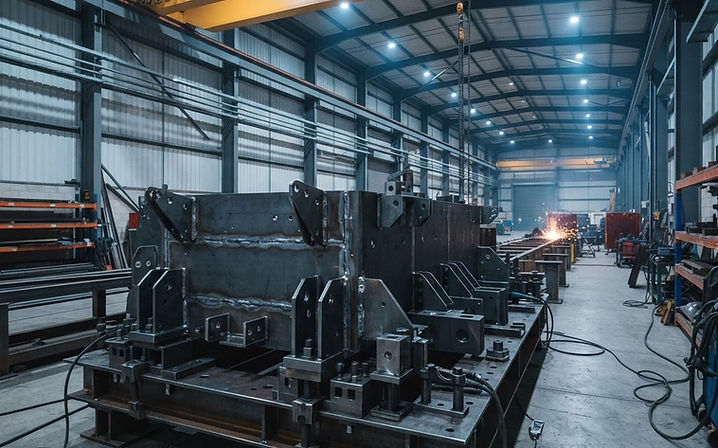
Thick plate weldments behave differently from structural steel. Distortion must be predicted, not corrected, so weld sequence, preheat, restraint and post weld stress relief are planned before the first tack. Where machining follows welding, we allow the machining stock and sequence the operations so the final bore, face or pocket is cut after the weld has moved the part.
Fabrication is carried out on jigs and fixtures that hold the geometry, with dimensional checks recorded at each stage. Welding procedures are qualified for the plate grades and thicknesses involved, welders are qualified to those procedures, and non destructive testing is performed to the class the drawing calls for, including magnetic particle and ultrasonic inspection of full penetration joints.
Confidentiality is managed through restricted drawing handling, named project teams and secure storage. Finished items are protected, marked to the client's identification scheme and packed for transport with certified lifting provisions, so the equipment arrives in the condition it left the shop.
What we fabricate
- Heavy plate and armour grade weldments
- Machined interfaces on welded structures
- Protective shelters, frames and mounting structures
- Jigs, fixtures and handling equipment
- Controlled welding with preheat and stress relief
- Confidential project handling and controlled documentation
Typical applications
- 01Vehicle and equipment mounting structures
- 02Protective and ballistic tested assemblies
- 03Shelters, containers and field support units
- 04Maintenance stands, cradles and handling frames
- 05Training and simulation support structures
- 06Precision brackets and machined sub assemblies
defence fabrication Thailand / heavy plate weldment fabrication / armour steel welding Thailand / precision fabrication Rayong / protective structure fabrication / jig and fixture fabrication / thick plate welding with preheat / confidential defence engineering supplier
Defence Engineering FAQs
Questions we are asked
Ten detailed answers on defence engineering fabrication, testing, delivery and documentation.
Heavy plate and armour grade weldments, machined structural assemblies, mounting frames, shelters and containers, protective structures, jigs, fixtures, maintenance stands and handling equipment, all fabricated to controlled drawings with full inspection records.
Drawings are handled by a named project team on a need to know basis, stored securely, and not shared outside the project. We can work under confidentiality agreements, restrict photography in the relevant shop areas, and hold project documentation in controlled files.
Yes, to qualified procedures that control preheat, interpass temperature and heat input to protect the parent material properties. Weld quality is verified with the non destructive testing the drawing class requires, including magnetic particle and ultrasonic inspection.
We plan machining stock into the weldment, sequence welding before final machining, and machine bores, faces and pockets to drawing tolerance on our machining equipment. Critical dimensions are recorded on an inspection report with the actual measured values.
Yes. We fabricate jigs, welding fixtures, lifting beams, cradles, stands and transport frames, designed for the load and certified for use. Lifting equipment is built with calculated and inspected lift points.
Distortion is managed through weld sequence planning, balanced welding about the neutral axis, preheat where required, restraint on fixtures, and stress relief after welding where the specification calls for it. The result is checked dimensionally before the part leaves the bay.
Visual, dimensional, magnetic particle, dye penetrant, ultrasonic and radiographic inspection are available through qualified technicians, with third party witnessing on request. Inspection and test plans are agreed with the client before fabrication starts.
Yes. We review the drawing package, raise manufacturability questions early, produce shop drawings for approval, then fabricate to the approved issue. Where a design detail cannot be built practically, we propose an alternative with the reasoning documented.
Items are protected with coatings or temporary protection, braced in crates or frames, lifting points marked, and packed to the client identification scheme. Documentation includes certificates, inspection reports and packing lists tied to the item serial numbers.
Yes. Not every defence requirement is a large structure. We handle small batch precision fabrication and repeat runs with the same documentation discipline as larger projects, which suits prototype, trial and support equipment work.
Request for quotation
Talk to us about your defence engineering package.
Send drawings, a scope or a sketch and our estimating team in Rayong will answer your enquiry within 48 hours, with a fabrication approach for your defence engineering project. The priced quotation follows once the scope is confirmed.